
First Holy Communion in America 💸🇺🇸⛪
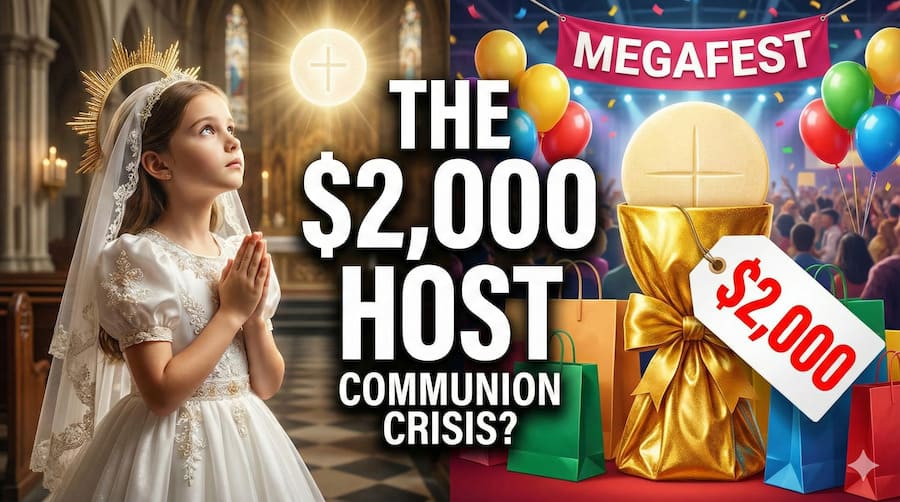
The $2,000 Host: How First Holy Communion in America Became a Cultural Megafest and a Battle for Belief
I. The Great Paradox: Where Faith Meets Financial Fervor and Doctrinal Drift 📉💰
The Holy Eucharist, the very center of Catholic worship and the theological pinnacle of the faith, is caught in a profound paradox in 21st-century America. Revered as the "source and summit" of spiritual life, the sacrament of First Holy Communion—the child's first reception of the consecrated Host—is simultaneously defined by deep doctrinal uncertainty and astonishing cultural extravagance.
The Crisis of Belief: Doctrine vs. Perception 🤯
Theological clarity is paramount: Catholics adhere to the doctrine of Transubstantiation, the belief that during the Mass, the entire substance of the bread and wine is truly changed into the Body and Blood of Jesus Christ (the Real Presence), while the external appearances remain the same. This profound mystery is the foundation of the faith.
However, statistics reveal a gaping chasm between doctrine and conviction:
- A pivotal 2019 survey by Pew Research found that only 31% of US Catholics overall believed in Transubstantiation. This low figure signals a massive theological drift within the baptized population.
- Crucially, a 2024 study provided vital context: among regular Mass-going Catholics, belief in the Real Presence soars to 69%.
This huge disparity is key: the core truth of the faith is being successfully transmitted almost exclusively through frequent, persistent engagement with the Mass. The crisis, therefore, is rooted in systemic disengagement and a failure of sustained catechesis across the wider Catholic population, whose low belief rate is driving the overall average down.
Low Participation and High Initiation Rates: A Contradiction 📊
The crisis in belief is mirrored by a persistent crisis in participation. Data holding steady into 2025 and 2026 confirms that in-person Sunday Mass attendance has only rebounded to its pre-pandemic baseline of roughly 24%. This means that the Church’s active reach is tragically limited to about one-quarter of its registered adherents.
Yet, despite low adult attendance, sacramental life continues: the U.S. recorded 7.3 First Communions per 1,000 Catholics in 2021, a rate higher than the global average of 6.2. This suggests a strong cultural adherence to initiating children into the faith, even if adult practice and doctrinal conviction lag.
| Metric: The State of Eucharistic Practice in the US Catholic Church (2025 Context) | Data Point | Implication for Faith & Culture |
| Weekly Mass Attendance Rate | 24% | Stable, but critically low participation rate, confirming the Church's reach is limited to a minority of registered Catholics. |
| Belief in Real Presence (Regular Mass-Goers) | 69% | Strong belief among frequent practitioners confirms that regular engagement fosters doctrinal conviction. |
| Belief in Real Presence (Overall US Catholics) | 31% | Highlights a massive theological drift and a systemic failure in sustained catechesis across the wider population. |
| First Communions per 1,000 Catholics (2021 baseline) | 7.3 | US initiation rate is higher than the global average (6.2), suggesting cultural adherence remains strong despite declining adult belief. |
The Mini-Wedding Effect: Costs Overshadowing the Sacred 👗💸
In stark opposition to the humility and sacrifice symbolized by the Eucharist, the celebratory parties surrounding the First Communion have become synonymous with extravagance in affluent American communities.
- Financial Baseline: Even small, private parties for 25 to 30 family members often cost between $1,500 and $2,000, setting a steep financial precedent.
- Luxury Services: The demand for professional services is immense. Parents willingly spend $100 to $500 on professional photography packages, often booking months in advance. Tellingly, some families even hire luxury vehicles at hourly rates starting at $40 to transport the communicants, emphasizing the performative nature of the celebration.
- Pastoral Concern: Clergy openly lament that this excessive spending has "overshadowed the actual beauty of the children receiving the sacrament," transforming a spiritual initiation into a societal and economic event.
II. The Age of Discretion: A Century of Custom and Change 🕰️🗝️
The way Americans celebrate First Holy Communion today is the result of two pivotal moments in Church history: a decree from 1910 and the cultural revolution following the Second Vatican Council.
Pius X and the Restoration of Ancient Law (1910) 📜
Before the 20th century, the age for Communion was often delayed until ages 12 or 14, influenced by spiritual rigorism that viewed the Eucharist as a reward for advanced spiritual maturity.
This delay was formally countered by Pope St. Pius X's 1910 decree, Quam Singulari. This decree definitively restored the "age of discretion" as the proper moment for reception, defined as approximately seven years of age. Pius X viewed the Eucharist as a necessary spiritual remedy for the soul's weaknesses, making it essential for all children who could distinguish the consecrated Host from common bread. The decree famously mandated that First Confession must precede First Communion. Today, preparation typically occurs during the child's first or second grade.
Vatican II: The Great Privatization of the Rite (1970s) 👨👩👧👦
While Pius X standardized the age, the Second Vatican Council (1962–1965) and subsequent liturgical reforms dramatically altered the customs and public dimension of the rite in the U.S. This transformation was the critical precondition for the extreme commercialization seen today.
In the 1960s, the rite was highly uniform and mandatory: children received Communion together on a fixed date (like Mother's Day) in a communal parish event, followed by a compulsory, high-profile May procession around the block.
Around 1970, practices changed dramatically, introducing flexibility and a personalized, family-centric approach.
- Individualized Reception: Families gained the option to choose a specific date and Mass for their child to receive Communion individually. The event moved from a single parish-wide date to being celebrated across multiple Masses.
- Family Inclusion: The custom of having the child's entire family—including non-Catholics—accompany the communicant to the altar for a blessing gained acceptance, emphasizing family unity.
- Fading Public Rites: The compulsory May procession and the mandatory group focus faded away entirely.
This transformation, shifting the rite from a mandatory, high-profile parish procession to flexible, individualized ceremonies, privatized the sacrament's cultural identity. As the ecclesial, community element retreated, the emphasis shifted automatically to the private, expensive, extended family celebration, cementing its status as a major family milestone rather than strictly a church-centered initiation.
| Aspect: Evolution of First Holy Communion Customs in the US | Pre-Vatican II (e.g., 1960s) | Post-Vatican II (Modern Custom, 2025) |
| Ceremony Timing | Standardized group Mass, often Mother's Day, Mandatory | Option for individualized date/Mass or combined group ceremony, Flexible |
| Attire Mandate | Mandatory white for boys and girls | White optional; girls retain elaborate white dresses/veils; boys wear "Sunday best" |
| Public Rites | Required May procession around the block | Procession generally faded away entirely |
| Family Inclusion | Recipients separated from family in the pews | Non-Catholics/full family may accompany child for a blessing |
III. The Path to Renewal: The 2025 Eucharistic Revival and the Faith Gap 🔥🧭
In direct response to the persistent crises of low participation, doctrinal drift, and increasing disaffiliation, the US bishops launched the three-year National Eucharistic Revival (2022-2025).
A. The Institutional Antidote: Revival and Congress 🗺️
The Revival, rooted in the biblical aspiration Desiderio desideravi ("I have eagerly desired to eat this Passover with you..."), is an institutional strategy to rekindle belief through intensive catechesis and spiritual outreach. Program is structured to bring the Eucharistic presence of Jesus to the people, inspiring missionary discipleship—the call to prayerfully accompany a friend or neighbor closer to the Church.
The Revival’s climactic events, taking place in 2025 and 2026, are designed to visually and spiritually unite the faithful:
- The Pilgrimage (May-June 2025): The Revival features a major cross-country pilgrimage, where the Blessed Sacrament is processed along four simultaneous routes across the U.S., culminating in Indianapolis.
- The Congress (July 2025): The entire effort culminates in the National Eucharistic Congress in Indianapolis (July 17–21, 2025), aiming to unite the fragmented Catholic community in a massive, public display of faith and doctrinal conviction.
The institutional conviction is that focusing on the mystery of the sacrifice and the theology of the Real Presence can serve as an antidote to the pervasive drift in belief and the commercialization of the sacrament.
B. The Intergenerational Faith Gap 👨👩👧
The preparation for First Communion exposes a severe intergenerational faith gap, which is the greatest barrier to sustained belief. Canonical law mandates that the preparation of children is primarily the duty of parents and pastors.
- Parental Reliance: Research confirms that the most effective vector for transmitting the core dogma of the Real Presence is parental teaching (53%).
- The Problem: Since the overall belief rate is only 31%, a large segment of parents preparing their children for the sacrament may themselves harbor theological doubts or lack deep doctrinal conviction.
This deficiency compromises the "domestic church"—the family unit, idealized as the primary center of faith formation. As a result, parish catechesis programs are effectively forced to re-evangelize the parents while simultaneously preparing the children, making the process a high-pressure, multi-year endeavor.
VI. Conclusion: Authenticity Over Extravagance in 2026 💖
The Eucharist remains the source and summit of the Catholic faith, yet its celebration is entangled in profound cultural contradictions. Challenge for the Church in 2025 and 2026 is to focus the faithful's attention back onto the sublime spiritual reality of the sacrament, rather than the social pressure surrounding the event.
The Church must find a way to impress upon the faithful that the spiritual readiness of the child (the age of discretion and the sincerity of the heart) is paramount, not the size of the party, the cost of the dress, or the hourly rate of the luxury vehicle. If the cultural demands of $2,000 parties and extravagant attire continue to define the event, the spiritual initiation risks being permanently defined as a mere social rite of passage.
The National Eucharistic Revival offers a strategic opportunity to reverse this trend, calling the American Catholic community back to the humble, life-sustaining mystery of the Host. The ultimate success will be measured by whether belief in the Real Presence can be restored and the emphasis shifted back from the spectacle of the feast to the sincerity of the heart.
If you want to find items related to First Holy Communion in America 💸🇺🇸⛪, you can search in Blog.
Deja una respuesta
Related